

Most people know something is off. They just don't know which part.
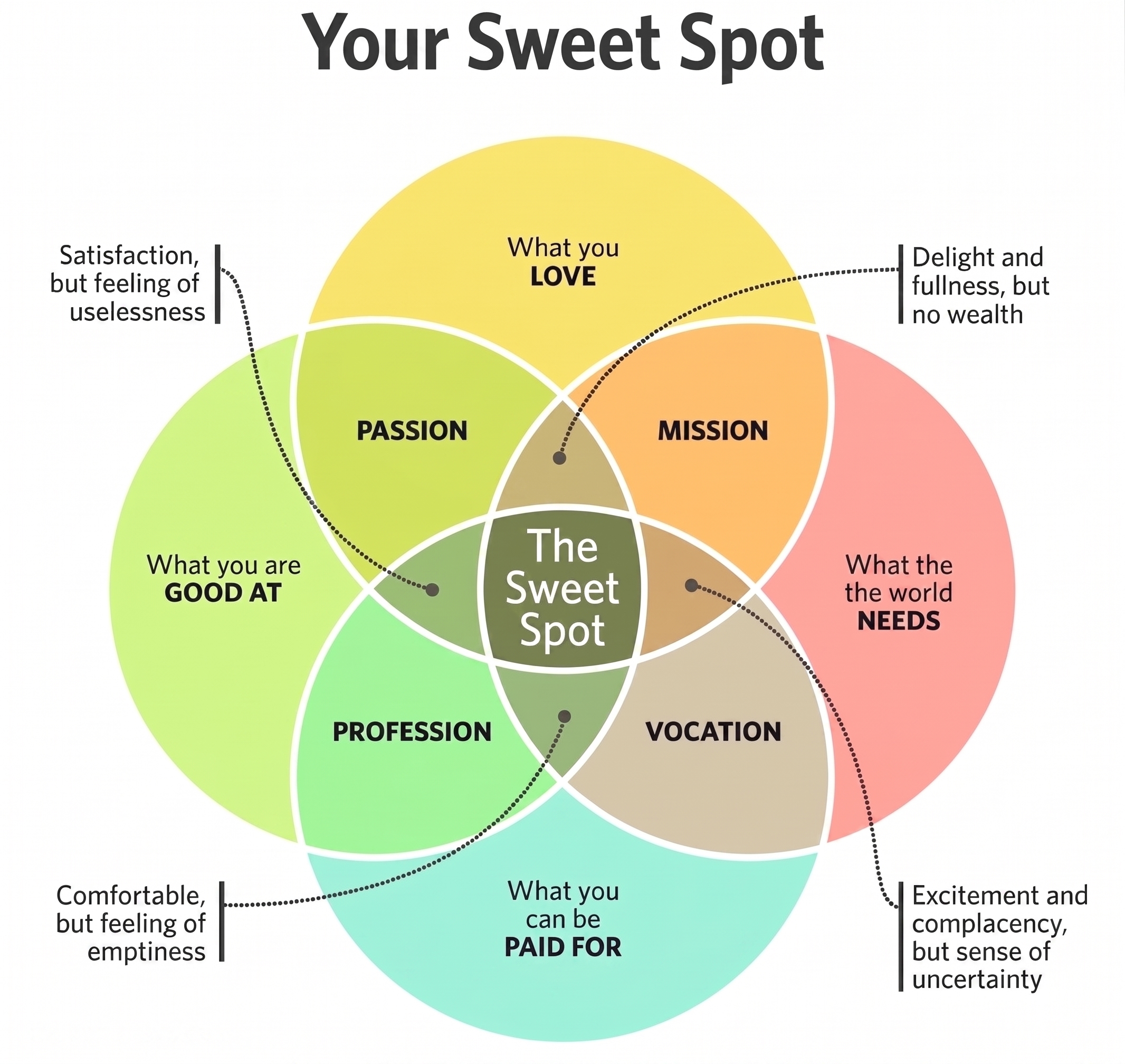
Your Sweet Spot is the place where four things converge: what you love, what you are genuinely good at, what the world needs, and what you can be paid for. Not one or two — all four, at the same time, in the same work.
When that convergence happens, something shifts. The work energises rather than drains. You get better at it naturally, because you care. It matters to others, so it sustains you financially. And it feels, unmistakably, like yours.
The problem is that most people optimise for one or two — usually income and skill, or passion and purpose — and quietly tolerate the gaps. Those gaps don't announce themselves. They show up as Sunday-night dread, a vague sense of wasted potential, or the feeling that you are performing a version of yourself that isn't quite right.
What would you keep doing even if no one paid you — and are you doing any of it right now?
Where does the world actually need you, not just someone with your job title?
Is there a version of your work that could feel like all four at once?
This app won't answer those for you. It will help you see clearly where you are, understand the gaps, and take one deliberate step toward closing them.
Two minutes to map it. What you find might take longer to act on.
How to use this app.
Three steps, in order. Each one builds on the last. Plan for about fifteen minutes end to end.
Step 1 — Assessment
This is where you build your personal map. You'll answer twelve questions — three for each of the four areas that make up the Sweet Spot model:
- What You Love — what energises you, what you gravitate toward naturally, what you would do even without a reward.
- What You're Good At — skills and strengths others recognise in you, things you pick up faster than most people.
- What the World Needs — the problems or causes that bother you most, where you feel most genuinely useful.
- What You Can Be Paid For — what people have actually paid you for so far, and what your most marketable skill is right now.
Answer honestly and instinctively — there are no right answers. This is about your natural disposition, independent of any job title you currently hold. The whole quiz takes about two minutes.
Reading your results
Once you finish, the app produces a synthesis showing where your four areas overlap. These overlaps have names:
- Passion — where Love and Skill meet.
- Mission — where Love and the World's Need meet.
- Profession — where Skill and Pay meet.
- Vocation — where the World's Need and Pay meet.
The Sweet Spot sits at the centre — where all four overlap at once. The synthesis also names the tensions: what it costs you when one or two of these are strong but their opposite is missing.
Choosing your feedback style
After your results appear, you can choose how you want the feedback delivered. There are three options:
- One Perspective — honest and warm, the way a close friend who genuinely cares tells you something true. There is a runway before the harder observation, but the harder observation is still there.
- An Honest Opinion — direct and plain-spoken, like a trusted mentor who respects you too much to soften the truth. The hardest observation comes first, in short sentences, with no easing in.
- What a coach will say — quick on the diagnosis, straight to what it means for what you do next. Less time on the why, more time on the what now.
Switching style re-generates your results from scratch in the new voice. Your answers don't change — only how the feedback is framed. You can switch as many times as you like. Use the My answers button at any time to review exactly what you chose for each of the twelve questions.
Step 2 — Your Current Positions
The Assessment tells you who you are. This step asks: how does that compare to what you're actually doing right now?
You can name up to three things you are currently working on — a job, a side project, a freelance role, anything that takes real time and energy. For each one, four short questions ask how much it draws on your Passion, Mission, Profession, and Vocation as identified in Step 1. Your answers map each project against your personal Sweet Spot.
For each project you'll see:
- A headline — a plain-language description of the gap pattern the scores reveal, for example: "Living your Passion, missing your Vocation."
- A narrative — two to four sentences on what that gap is quietly costing you if it stays unaddressed.
- Overall fit — an average score across all four areas.
- Bottleneck — the single weakest area for this project. This is the thing most likely capping everything else.
This is not a pass/fail test. Most work sits somewhere between the extremes, with genuine trade-offs. The goal is to see the picture clearly, not to judge it. The same three feedback styles from Step 1 are available here — switching tone re-runs the read for all your positions at once.
Step 3 — Strategies
Once you can see the gap between who you are and what you're doing, the question becomes: what do you actually do about it? This step helps you think that through for each project.
It works in three parts:
- Your honest evaluation — before any advice, you answer one question: is what you're doing on this project getting you closer to what you said you wanted, or not? Four options from "Yes, clearly" to "No, further away." Only you can answer this honestly.
- Strategy options — once you've evaluated, the app generates two or three named directions specific to your bottleneck. Each comes with a clear trade-off stated plainly — what choosing this direction actually costs or forecloses. At least one option will be about closing the gap inside the project; at least one will be about accepting the trade and meeting that need somewhere else.
- Refine it in conversation — once you pick a direction, you can talk it through with the app. It will push back, ask sharper questions, and help you shape the direction into something that is actually yours. It won't hand you a finished plan — that part is yours to write.
A few things worth knowing
- Passion and Vocation are opposites in the model, as are Mission and Profession. Being strong in one without its opposite creates a specific, recognisable strain. The tension descriptions throughout the app name what that strain looks and feels like.
- There is no saved state between sessions. If you close the app or refresh the page, your answers are lost. Try to work through all three steps in one sitting.
- The AI reads your answers, not your life. It will find patterns and name them plainly, but it can only work with what you gave it. If an observation doesn't land, push back on it — that's what the conversation step is for.
Your natural disposition, independent of any job.
Twelve quick taps — no essays — and a synthesis of where love, skill, the world's need, and pay overlap for you specifically.
Where your answers meet.
This is a mirror, not a verdict. Read it, argue with it, keep what's true.

Synthesis
Where each thing you're doing actually lands.
Not black and white — real work has shades of grey and trade-offs. Some of this is near your Sweet Spot. Some of it may be right in it.